
From Volatility to Velocity:
5 Leadership Search Predictions for 2026
As we analyzed in our Retrospective 2025 , last year was defined by a “two-speed” talent market. It was a year of contrast: cautious organizations adopted a “hire slow, fire fast” mentality , tightening their risk tolerance with increased psychometrics and due diligence , while bold players quietly launched confidential searches to pivot or expand into the US.
But as we enter 2026, the game is changing again. We are moving from a period of observation to a period of strategic velocity.
The “Silver Tsunami” is no longer a forecast – it is an operational reality. Trade volatility is no longer a risk to be watched – it is a baseline condition requiring action. The “intentional candidates” we saw emerge in 2025 are no longer just looking for stability; they are looking for impact.
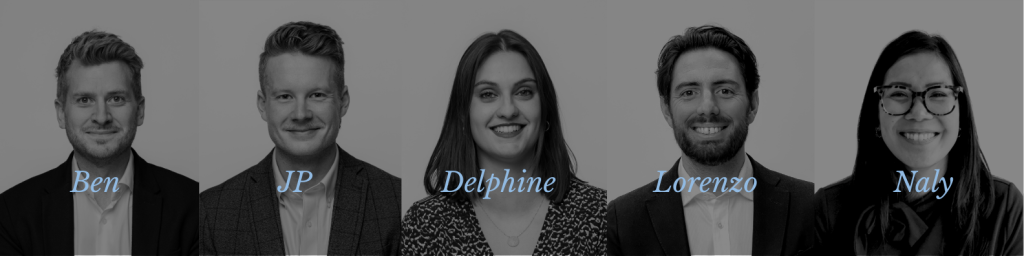
1. The Year of the Repreneur: Closing the "Operator Gap" - Benjamin leclaire
The transfer of wealth from retiring founders to a new class of buyers – Search Funds, Family Offices, and Repreneurs – is accelerating. However, the risk in these transactions has shifted. It is no longer just about financial engineering; it is about human engineering.
We predict that 2026 will be defined by the “Operator Gap” – the vacuum of leadership created when a founder departs. But identifying the right talent goes beyond a standard search. Human due diligence requires a deep reading of the company’s context.
It is this organizational context that defines the contours of the profile needed. Buyers are realizing that acquiring cash flow does not mean acquiring a functional organization.
Consequently, we are seeing a pivot in search mandates: away from generic “managers” and toward “Integrators”. These are operators capable of executing a business plan within the specific reality of the acquired company, without relying on the founder’s intuition.
The Takeaway: In 2026, Talent Due Diligence will become as critical as Financial Due Diligence.
2. The Cross-Border Imperative: Localization is the New Trade Strategy - JP Holliday
With tariffs and geopolitical instability dominating the headlines, businesses can no longer rely solely on cross-border shipping. They need boots on the ground.
Canada to US: We are seeing a “flight to quality” where Canadian firms are bypassing trade friction by hiring US-based Business Development leadership directly.
France to Canada/US: For European firms looking to acquire distressed assets in North America, the challenge is cultural. You cannot simply air-drop an executive from HQ into a foreign subsidiary.
Success in 2026 will depend on a fine reading of different cultures. It requires “Cultural Translation” – finding local leaders who possess the rare ability to navigate both the local market nuances and the reporting requirements (and cultural standards) of an international parent company.
3. The Renaissance of Cost Centers: Strategic Support Returns - Delphine Dujardin
After a year or two of “lean” operations and frozen headcounts, the demand for support roles is returning. As capital becomes accessible again, organizations are looking to reinvest in their backbone – specifically in Marketing, HR, and IT.
However, this is not a return to the volume-based hiring frenzy of 2021.
The mandate for 2026 is de-risking investment. Companies are seeking functional leaders who act as “Efficiency Architects.” The goal is not to build massive teams, but to find leaders who can leverage AI, automation, and modern tooling to deliver outsized results with a lean structure.
The future belongs to Cost Center leaders who understand that their role is no longer just to support the business, but to multiply its capacity through technology.
4. The Infrastructure Boom: Sovereignty Drives the Search - Lorenzo De Angelis
While the residential construction sector remains uneven, we are witnessing an explosion in projects tied to economic sovereignty: critical minerals, energy infrastructure, and Public-Private Partnerships (P3).
These are not standard construction mandates. They require a sophisticated leadership profile: executives who possess the agility of the private sector but the political acumen to navigate complex public stakeholder maps. As Canada doubles down on self-sufficiency, the competition for these “hybrid” leaders will be fierce.
5. The Modern CFO: Splitting Strategy from Reliability
We have long advocated for the EOS model of the “Visionary” CEO and the “Integrator” COO. In 2026, we see this model applying urgently to the Office of the CFO.
In many SMEs, the CFO is trapped in the minutia of month-end closings and compliance, preventing them from acting as a true strategic partner to the CEO. To fix this, we predict a surge in demand for high-level Corporate Controllers acting as “Financial Integrators.”
By hiring a strong number-two to lock down the reliability of the data, organizations free their CFO to focus on capital strategy, M&A, and external relations. It is the only way for the finance function to scale at the pace of the market.
Conclusion: De-Risking Your talent
In a volatile market, the greatest risk to your strategy isn’t financial. It is human.
De-risking talent requires more than a resume check; it demands deep acculturation and a mastery of context. We find leaders who don’t just fit the role, but fit your specific reality. Ensure your boldest moves in 2026 are also your safest.
Ready to de-risk your next hire?